


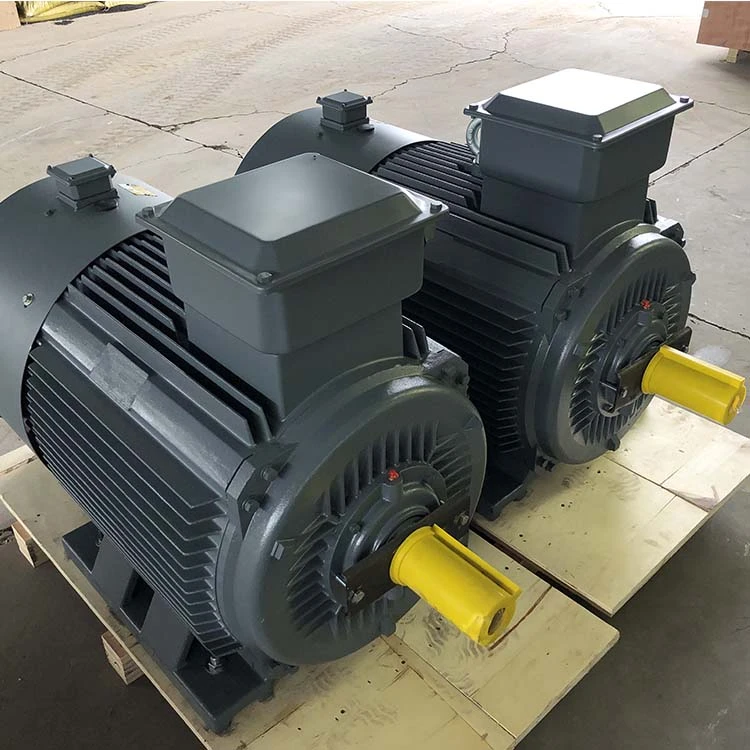
General purposeVariable frequency speed control motors have the following characteristics compared to ordinary motors:
Variable Frequency Motors
● Powered by a frequency converter.
● Replaces the traditional motor fan with an independent fan.
● The insulation performance requirements for the motor windings are higher than those for ordinary motors.
● Due to the special nature of Variable frequency speed control motors use, they are prone to motor resonance during startup. Therefore, the rigidity of the motor components and the overall structure should be fully considered to prevent vibration and noise problems.
● Insulation class is generally selected as F or higher, with enhanced insulation to ground and inter-turn insulation strength to improve the motor's ability to withstand impulse voltage.
● Special electromagnetic wire for variable frequency speed motors is used, especially for high-power motors, where requirements are more stringent due to varying application environments.
● Forced ventilation cooling is required. Compared to ordinary motors, motor speeds are not constant. If a built-in fan is used for cooling, the motor's ventilation and heat dissipation effect will be significantly reduced; therefore, an independent ventilation and heat dissipation scheme must be adopted.

Generally, axial flow fans are used for forced ventilation. It is particularly important to note that the fan and motor must not share a power supply.
● Manufacturing process control. Vacuum pressure impregnation manufacturing processes and special insulation structures ensure the insulation withstand voltage and mechanical strength of the electrical windings.
● Improved rotor dynamic balance control to enhance component machining accuracy; selection of high-performance bearings allows for high-speed operation.
Variable Frequency Motor Testing:
Generally, Variable frequency speed control motors typically require a frequency converter for power supply.. Because the output frequency of a frequency converter has a wide range of variation, and the output PWM wave contains abundant harmonics, traditional current transformers and power meters are no longer sufficient for the measurement requirements of the test.
Furthermore, general Hall voltage and current sensors do not control or calibrate the phase angle error index, which directly affects the accuracy of power measurement.
Therefore, variable frequency speed control motors testing should utilize a variable frequency power analyzer and variable frequency power sensor with clearly defined phase angle error and phase angle error indicators as the primary electrical measuring instruments.
Hot Tags: variable frequency speed control motors, China variable frequency speed control motors manufacturers, suppliers, factory


